
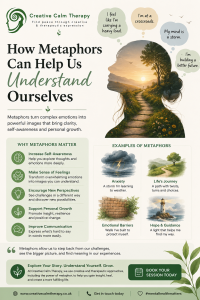
 Have you ever said you feel like you're "carrying the weight of the world on your shoulders", "stuck in a rut", or "at a crossroads in life"?
These common expressions are examples of metaphors—powerful tools that help us describe our thoughts, feelings, and experiences. While they may seem like everyday phrases, metaphors can reveal a great deal about how we see ourselves and the challenges we're facing.
In therapy, metaphors are often used to help people explore emotions, gain clarity, and develop greater self-awareness. By turning complex feelings into images, stories, or symbols, metaphors can make difficult experiences easier to understand and navigate.
But what is a metaphor?
A metaphor is a way of describing one thing by comparing it to something else. Rather than explaining an emotion directly, a metaphor uses imagery or symbolism to communicate meaning.
For example:
- "I'm drowning in responsibilities."
- "My anxiety feels like a constant alarm bell."
- "I've hit a brick wall."
- "I'm wearing a mask around other people."
These metaphors often communicate emotions more effectively than simply saying "I'm stressed" or "I'm struggling."
They provide valuable clues about how we interpret our experiences and can open the door to deeper self-understanding.
Metaphors and self-awareness.
Developing self-awareness is a key part of emotional wellbeing. However, understanding our inner experiences isn't always easy.
Sometimes emotions feel confusing, overwhelming, or difficult to put into words.
Metaphors can help by:
- Making abstract feelings easier to understand
- Encouraging reflection and insight
- Helping us identify emotional patterns
- Providing a safe way to explore difficult experiences
- Supporting emotional expression and communication
When we describe our feelings through metaphor, we often uncover perspectives we hadn't previously noticed.
Metaphors in Therapy.
Many therapists use metaphor therapy techniques to help clients explore thoughts, emotions, and behaviours in a non-judgemental way.
For example, a person experiencing anxiety may describe it as:
"A smoke alarm that goes off even when there's no fire."
This metaphor creates distance between the individual and the problem. Rather than seeing themselves as the problem, they can begin exploring how their "alarm system" developed and what might help regulate it.
Questions might include:
- What triggers the alarm?
- When is it helpful?
- When does it become overwhelming?
- What would a balanced alarm system look like?
This process can lead to greater understanding, self-compassion, and practical strategies for managing challenges.
Understanding emotions through a metaphor.
Metaphors can help us visualise our emotional experiences in ways that feel less intimidating.
Emotions as Weather
One common therapeutic metaphor is viewing emotions as weather.
- Anxiety may feel like a thunderstorm.
- Sadness might resemble a grey, rainy day.
- Anger could be a powerful gust of wind.
- Joy may feel like sunshine breaking through the clouds.
This metaphor reminds us that emotions, like weather, are constantly changing. No feeling lasts forever.
Life as a Journey
Many people naturally describe life as a journey.
Along that journey, we may encounter:
- Obstacles
- Detours
- Crossroads
- Mountains to climb
- New paths to explore
Viewing life in this way can help us recognise that setbacks are part of the process rather than signs of failure.
Metaphors and personal growth
One of the greatest benefits of metaphorical thinking is its ability to support personal growth.
Consider the metaphor of a garden.
Your wellbeing might be viewed as a garden that requires care and attention.
You could ask yourself:
- What areas of my life are thriving?
- What needs nurturing?
- What habits are helping me grow?
- What "weeds" might be preventing progress?
This simple exercise can provide valuable insights into relationships, self-care, mental health, and future goals.
Creative therapy and the power of symbolism.
Creative therapies often use metaphor and symbolism to help people express experiences that are difficult to communicate through words alone.
Through activities such as:
- Art therapy
- Creative journaling
- Storytelling
- Visualisation exercises
- Therapeutic writing
Individuals can explore emotions, experiences, and personal narratives in a meaningful and accessible way.
A drawing of a bridge, for example, might represent transition and change, while a lighthouse could symbolise hope, guidance, or resilience during difficult times.
These creative metaphors often provide powerful opportunities for healing and self-discovery.
How to use metaphors for self-reflection.
You don't need to be in therapy to benefit from metaphors.
The next time you're facing a challenge, try asking yourself:
- If my life were a journey, where am I right now?
- If my emotions were a landscape, what would it look like?
- If my current challenge were an object, what would it be?
- If I were writing a chapter of my life story, what would this chapter be called?
These reflective questions can help you better understand your thoughts, emotions, and experiences.
The connection between metaphors and mental wellbeing.
Research and therapeutic practice have shown that storytelling, imagery, and symbolic thinking can help people process emotions more effectively.
Metaphors encourage curiosity rather than judgement.
Instead of thinking:"There's something wrong with me."
You might think: "I'm navigating a storm."
The challenge remains real, but the perspective changes. This shift often promotes greater self-compassion, resilience, and emotional flexibility.
Final thoughts.
Understanding ourselves isn't always straightforward. Emotions can be complex, and life experiences don't always fit neatly into words.
Metaphors offer a powerful way to make sense of our inner world. They help us explore emotions, recognise patterns, and gain fresh perspectives on the challenges we face.
Whether through therapy, creative expression, or personal reflection, metaphors can become valuable tools for self-awareness, emotional wellbeing, and personal growth.
By paying attention to the metaphors we use, we may discover that they reveal more about us than we realise.
At Creative Calm Therapy, we use creative and therapeutic approaches to help individuals explore emotions, build self-awareness, and improve emotional wellbeing. Through metaphor, storytelling, creative expression, and person-centred support, we create a safe space where you can better understand yourself and your experiences.
Whether you're navigating anxiety, life transitions, low self-esteem, or simply seeking personal growth, we're here to support you.
Ready to begin your journey of self-discovery?
Contact Creative Calm Therapy today to learn more about our therapeutic services and how creative approaches can help you gain clarity, resilience, and emotional balance.
Take the first step today.
✅ Explore your emotions in a safe, supportive environment
✅ Develop greater self-awareness and confidence
✅ Discover creative tools for healing and personal growth
✅ Build resilience and emotional wellbeing
Visit: www.creativecalmtherapy.co.uk
Book your first session and start exploring the story behind your experiences today.