
The Gift of Anger: Why We Need to Normalise Anger Rather Than Fear It.
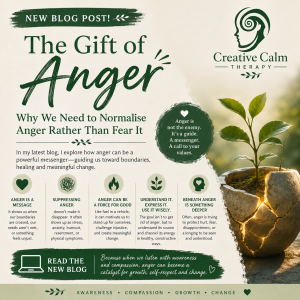 As therapists, we often sit with people who tell me they are not angry or that they fear to express it. Yet as we explore their experiences more deeply, anger begins to emerge in many different forms. Sometimes it appears as anxiety, resentment, burnout, perfectionism, irritability, people-pleasing, depression, emotional numbness, or even physical symptoms. Anger has a remarkable way of making itself known when it is not acknowledged.
For many of us, anger has been given a bad reputation. We are taught that it is dangerous, inappropriate, or something to suppress. We may have grown up in families where anger was explosive and frightening, or perhaps in environments where expressing anger was discouraged altogether. As a result, many people learn to disconnect from this emotion rather than understand it.
One of the most powerful perspectives on anger comes from Arun Gandhi's book The Gift of Anger, where he shares lessons learned from his grandfather, Mahatma Gandhi. Contrary to what many people assume, Gandhi did not believe anger was something to eliminate. Instead, he viewed anger as a natural and necessary human emotion. He described it as an energy that can help us recognise injustice and motivate positive change when it is channelled wisely. Arun Gandhi recounts his grandfather comparing anger to fuel in a vehicle: without it, we would not be motivated to respond to what is wrong or unfair in the world.
This idea resonates deeply with what I see in clinical practice. Anger is often an important messenger. It tells us when a boundary has been crossed, when our needs are not being met, when we have been hurt, or when something feels unjust. In this sense, anger is not the problem. The problem often lies in what we do with it.
Many people have learned only two ways of dealing with anger: exploding or suppressing. Neither tends to serve us well. Explosive anger can damage relationships and leave us carrying regret. Suppressed anger, however, does not simply disappear. It often becomes internalised, contributing to stress, anxiety, low mood, self-criticism, and emotional exhaustion.
What if we viewed anger differently? What if, instead of seeing it as something to fear, we saw it as information?
When we become curious about our anger, we can begin asking important questions. What is this feeling trying to tell me? What value has been violated? What need is unmet? What boundary requires attention? Arun Gandhi spoke about the importance of understanding the source of anger rather than simply reacting to it. The goal was not to deny the emotion but to use it constructively and intelligently.
In recent years, I believe conversations about emotional wellbeing have become more open, yet anger often remains the emotion people feel least comfortable discussing. We readily talk about stress, anxiety, and sadness, but anger can still carry shame. Many clients worry that acknowledging anger makes them a bad person. In reality, anger is one of the most human emotions we experience.
Normalising anger does not mean encouraging aggression or hostility. It means recognising anger as a valid emotional response. It means creating space to understand it, express it safely, and use its energy in ways that align with our values. Anger can help us advocate for ourselves, leave unhealthy situations, challenge injustice, and make meaningful changes in our lives.
As therapists, we have come to see anger not as an enemy but as a guide. Beneath anger there is often hurt, fear, grief, disappointment, or a longing to be seen and understood. When we listen carefully, anger can point us towards healing.
Perhaps the gift of anger is not the emotion itself, but what it reveals. When approached with awareness and compassion, anger can become a catalyst for growth, self-respect, and positive change. Rather than asking how we can get rid of anger, perhaps the better question is: what is our anger trying to teach us?
If we can learn to listen, we may discover that anger has been speaking on our behalf all along.
If you want to explore your anger contact us at: https://creativecalmtherapy.co.uk/?preview#contact