For years, I kept my two worlds strictly separated. In one room, I was the therapist—focused, professional, holding space for the heavy, complex narratives of my clients. In the other, I was the artist and knitter and even crocheter—messy, tactile, and deeply focused on the repetitive, meditative rhythm of creating something from nothing.
For a long time, I thought that to be a "serious" therapist, I had to keep the artist, creative in me,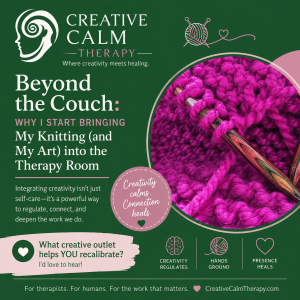 hidden. I worried that if a client saw me as someone who spent their weekends knitting or painting, it might undermine the clinical "blank slate" which doesn’t align with who I am anyway.
But as I navigated the inevitable fatigue that comes with holding space for others, I realized something important: the separation I had created wasn't helping me, and it wasn't helping my clients.
When I finally brought my art into the frame, everything changed. I stopped seeing my knitting merely as a hobby and started recognizing it for what it truly is: a somatic intervention.
When I knit, I am engaged in bilateral stimulation. I am practicing rhythmic regulation. I am achieving a "flow state" that quiets the ruminating mind. When I realized that my hands were doing exactly what I encourage my clients to do—finding ground, calming the nervous system, and engaging with the present moment—I knew I had to bridge the gap.
And I am not alone in believing this, there are so much research that back up my believes. My growing appreciation for knitting as a regulatory practice is supported by the emerging field of Craft Psychology, developed by Danish psychologist, craft educator, and researcher Dr. Anne Kirketerp.
Craft Psychology explores why creating things with our hands has such a profound impact on wellbeing. Drawing on her own research and a review of hundreds of scientific studies, Kirketerp argues that craft activities can promote mental health through several interconnected mechanisms, including flow, sensory engagement, skill development, meaning-making, and social connection.
According to Kirketerp, people who engage in craft activities frequently describe experiences of:
- Flow and deep concentration
- A sense of calm and presence
- Increased positive emotion
- Feelings of competence and mastery
- Greater meaning and purpose
- Relief from stress and anxiety
One aspect of Craft Psychology that resonates strongly with my own experience is the concept of flow, originally developed by psychologist Mihaly Csikszentmihalyi. When we become absorbed in a creative task such as knitting, our attention narrows to the present moment.
Importantly, Craft Psychology does not suggest that knitting or art replaces therapy. Rather, it proposes that creative engagement can serve as a powerful wellbeing practice that supports emotional regulation, reduces stress, and helps people reconnect with themselves and others, this is why I am starting to introduce art and knitting as grounding and self-regulating practices.
Another supporterClinical Psychologist Dr Mia Hobbs has been an important voice in exploring the therapeutic benefits of knitting. Through her clinical work, workshops, research discussions, and her Why I Knit podcast, she highlights how knitting can support emotional regulation, grounding, self-compassion, and connection. Hobbs suggests that knitting offers a practical way to redirect attention from anxious or repetitive thoughts while creating a tangible sense of progress and achievement. She has also written about how knitting can help people engage in difficult conversations, particularly when having something meaningful to do with their hands reduces self-consciousness and lowers barriers to communication.
As on of the therapist of Creative Calm Therapy, I no longer feel the need to separate my creative self from my therapeutic work. Instead, I have started to embrace the ways colour, texture, movement, and making can support emotional wellbeing.
Sometimes this means sharing a tactile activity with a client who cannot yet find the words for their anxiety. Other times it involves helping clients reconnect with familiar grounding practices that have been lost amidst stress, grief, or life transitions.
And sometimes, it simply means allowing my own knitting practice to remind me of the value of slowing down, staying present, and creating space for regulation—both for myself and for the people I work alongside.
As therapists, we are in a profession that requires us to pour from our own cups every day, often without remembering to refill them. Burnout isn't just about the number of clients we see—it can happen when we neglect the creative, playful, and deeply human parts of ourselves that exist outside of our professional roles. That's why I believe it's important to model grounding and self-care practices for our clients, showing that regulation is not just something we teach, but something we actively practice.
When I show my clients that I have ways to regulate my own nervous system outside of talk therapy, I am modelling a vital human skill.
As part of this journey, I am currently undertaking the Masterclass Certificate in Mindful Knitting for Emotional Healing to further develop my knowledge and skills in the therapeutic potential of knitting and creative practice.
My goal is to continue integrating evidence-informed approaches that support emotional wellbeing, self-regulation, and resilience, ensuring I can bring the best of both my clinical expertise and ongoing professional development into my work with clients.
At Creative Calm Therapy, I’m exploring how we can weave these practices into our professional lives to not only prevent burnout but to deepen the work we do with our clients.
I’d love to hear from you: What is the creative outlet that helps you reset?
Let’s keep the conversation going.
Mihaela Marian MBACP humanistic person centred, integrative and creative counsellor.