Anxiety: Learning to Separate Facts from Fear
By Creative Calm Therapy therapist Mihaela Marian
If you've ever found yourself lying awake at night replaying conversations, worrying about things that haven't happened, or feeling overwhelmed by "what if" thoughts, you're not alone. I see anxiety affect people in many different ways, and I know how exhausting it can feel when your mind won't slow down.
One of the most important lessons I've learned about anxiety is this:
Anxiety often thrives on thoughts, not facts.
Understanding Anxiety
When I work with individuals experiencing anxiety, I often explain that anxiety is the body's alarm system. It exists to protect us from danger. The problem is that sometimes the alarm becomes overly sensitive.
Instead of responding to actual threats, anxiety starts responding to possibilities:
- What if I fail?
- What if something goes wrong?
- What if people judge me?
- What if I can't handle it?
These thoughts can feel incredibly real. They can create physical symptoms like a racing heart, muscle tension, restlessness, difficulty concentrating, and trouble sleeping.
The challenge is that anxiety doesn't always distinguish between a possibility and a probability.
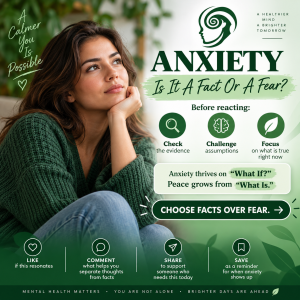
Is It a Fact or a Fear?
When anxiety starts to take over, I encourage people to pause and ask themselves a simple question:
"Is this a fact or a fear?"
Anxiety often convinces us that our fears are facts. It tells us that the worst-case scenario is likely to happen. It fills in the blanks with assumptions and uncertainty.
When I notice anxiety showing up, I try to ask myself:
- What evidence do I have?
- What facts support this thought?
- What facts challenge this thought?
- Am I reacting to reality or to a prediction?
This simple shift can be incredibly powerful.
I've found that many anxious thoughts lose some of their power when they're examined through the lens of evidence rather than emotion.
Coping Strategies I Encourage
While anxiety may not disappear overnight, there are practical strategies that can help manage it more effectively.
- Focus on What Is True Right Now
Anxiety pulls us into the future.
I try to bring myself back to the present by asking:
"What do I know to be true right now?"
Focusing on current facts helps interrupt the endless cycle of "what if" thinking.
- Challenge the Story Anxiety Is Telling
Anxiety often creates a narrative that assumes the worst.
When I notice this happening, I ask:
- Is there another explanation?
- What would I tell a friend in this situation?
- Have I overcome challenges like this before?
These questions help create a more balanced perspective.
- Practice Self-Compassion
Many people become frustrated with themselves for feeling anxious.
Instead of criticizing myself, I try to remember that anxiety is a human experience. I don't have to judge myself for having anxious thoughts.
I can acknowledge them without believing them.
Grounding Strategies I Often Recommend
When anxiety becomes overwhelming, grounding techniques can help reconnect us with the present moment.
The 5-4-3-2-1 Technique
I often recommend:
- 5 things you can see
- 4 things you can touch
- 3 things you can hear
- 2 things you can smell
- 1 thing you can taste
This exercise gently shifts attention away from anxious thoughts and back to the present environment.
Feel Your Feet on the Ground
One of the simplest grounding techniques is to notice where your feet connect with the floor.
I encourage people to pause and pay attention to:
- The pressure beneath their feet
- The temperature of the floor
- The feeling of being physically supported
Sometimes the simplest techniques are the most effective.
Create a Grounding Statement
I often suggest choosing a phrase to repeat during difficult moments:
- "I am safe right now."
- "This feeling will pass."
- "I can handle this one step at a time."
- "Thoughts are not facts."
A grounding statement can provide reassurance when anxiety feels overwhelming.
When Additional Support May Help
There are times when anxiety becomes more than occasional worry.
If anxiety is affecting your relationships, work, sleep, or overall quality of life, seeking support can be an important step.
I believe asking for help is one of the strongest things a person can do. Therapy can provide a safe space to understand anxiety, develop coping tools, and build confidence in your ability to manage difficult emotions.
Final Thoughts
If there is one message, I hope you take away from this article, it is this:
Anxiety thrives on "What If?"
Peace grows from "What Is."
You don't have to believe every thought that enters your mind.
You can pause.
You can question the thought.
You can check the facts.
And with practice, you can learn to respond to anxiety with greater confidence, compassion, and calm.
Ready for Support?
If you're struggling with anxiety and looking for support, I'm here to help.
At Creative Calm Therapy, our goal is to provide a compassionate, supportive space where you can learn practical tools, build resilience, and move toward lasting emotional wellness.
📧 Contact us at: creativecalmtherapy@gmail.com
Your journey toward a calmer, healthier future can begin with a single conversation.